A.32 Koppers Barge Canal, SC
A.32.1 Contacts
Regulatory Contact: Craig Zeller, USEPA ([email protected])
A.32.2 Summary
|
Environment: |
Marine Embayment |
|
Scale: |
Full |
|
Contaminants of Concern: |
PAHs (primary), arsenic, dioxin, pentachlorophenol, lead, chromium, and copper |
|
Source Control Achieved Prior to Remedy Selection? |
No |
|
Final Remedy: |
MNR for the Barge Canal (3.2 acres), cappingTechnology which covers contaminated sediment with material to isolate the contaminants from the surrounding environment. and dredging portions of the Ashley River (5.3 acres) |
|
Expected Recovery Time: |
5 years |
|
MNR viewed as a success? |
Yes |
A.32.3 Site Description
The Koppers Co., Inc. Barge Canal site lies to the west of the Ashley and Cooper Rivers, in northern Charleston, South Carolina. The site covers approximately 102 acres and includes land, drainage ditches, a barge canal, estuarine marshes, and a portion of the Ashley River. The primary source of the contaminants is from past direct discharges and releases from wood treating operations, as well as past and fugitive releases from upland soils and groundwater.
From the 1940s to 1977, an approximately 45-acre segment of this site was used for wood treatment operations. Creosote was the primary preservative; however, pentachlorophenol and copper-chromium-arsenate were also used. Water from creosote separation tanks were discharged into ditches that lead to the Ashley River.
From 1953 to 1968, Koppers leased approximately 4 acres to the south of its property where it disposed of sawdust, bark, and other wood waste materials. In 1984, the 3.2 acre Barge Canal was dredged eastward from the Ashley River to the Koppers property. This resulted in exposure of treated (creosote) wooden poles, highly turbid water, an oily sheen on the Ashley River and a fish kill ¼ mile downstream of the canal. It is believed that the canal was dredged through the area formerly leased by Koppers.
CSM summary: The Ashley River is naturally elevated in suspended solids (silts/clays) which are deposited within the quiescent environment of the Barge Canal with each tidal cycle. Consequently, the primary natural recovery process at the Koppers site is physical isolation of contaminated sediments via the natural deposition of suspended sediment from the Ashley River (> 2 cm/year). Lines of evidence collected to demonstrate this include transects of sediment cores which show a decreasing trend in the concentration of PAHs over time, and deposition modeling, bathymetric and hydrographic surveys, and aerial photography.
A.32.4 Remedial Objectives and Approach
Concerns for this case study include both ecological and human health risks:
- Ecology: risks for benthic communities, fish, mammals and birds
- Human health: industrial and off-site resident exposures
The 1998 ROD did not define specific RAOs. The ROD stated that “the primary evaluation criteria for sediments in the Ashley River, Barge Canal and tidal marshes is the long-term protection of ecological resources.”
Final selected remedy: MNR for the Barge Canal (3.2 acres), capping and dredging portions of the Ashley River (5.3 acres) adjacent to the Barge reach.
Lines of evidence collected during the remedial design phase established that physical isolation was a significant natural recovery process. This finding changed the initial subaqueous capping remedy decision outlined in the 1998 ROD to MNR, as detailed in the 2003 Explanation of Significant Differences.
The primary lines of evidencePieces of evidence are organized to show relationships among multiple hypotheses or complex interactions among agent, events, or processes. A weight of evidence approach includes the assignment of a numeric weight to each line of evidence. used to investigate MNR and physical isolation included a two-dimensional hydrodynamic and sediment transport modeling study, bathymetric surveying to document sedimentation rates, and aerial photography to document vegetation encroachment suggestive of sedimentation.
A.32.5 Monitoring
Monitoring elements: Monitoring focused on two areas: physical isolation and risk reduction. Elements covering physical isolation include bathymetric surveys to determine net sediment deposition and aerial photography to document sedimentation and vegetation encroachment. Risk reduction monitoring includes surface sediment chemistry analysis to monitor concentration of total PAHs in sediment samples.
The Second Five-Year Review determined that the MNR remedy is adequately protective and recommended discontinuing monitoring of sediment and vegetation encroachment in the Barge Canal.
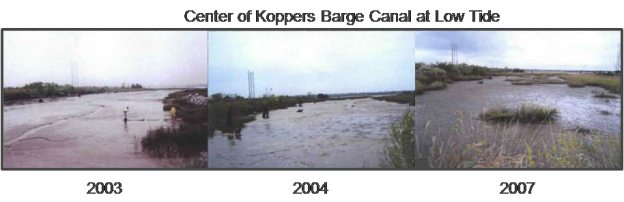
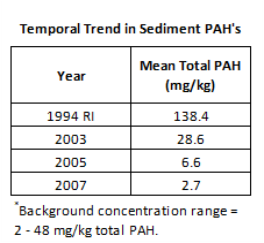
A net sediment accumulation of 0.5-2 ft was demonstrated in the central portion of the Barge Canal and for some areas net accumulation reached approximately 5 ft. Aerial photography showed a net accumulation of approximately 0.319 acres of vegetation between 2000 and 2004 which increased to 0.80 acres between 2000 and 2007. Finally, PAH concentrations have been decreasing, and the last three sampling events (2003, 2004, and 2007) were within the background range for Ashley River sediment.
Expected recovery time: 5 years
Monitoring cost: Because total PAH concentrations are at background levels and unlikely to decrease further, and that marsh vegetation continues to develop due to the dominant depositional environment, no additional monitoring of sediment quality in the barge canal is warranted.
RAOs/project objectives achieved? Overall the MNR implemented and monitored at the Former Koppers Barge Canal is viewed as a success.
A.32.6 Costs
The choice of MNR over the alternative remedial plan (subaqueous capping) saved a total of $447,000 that was estimated if subaqueous capping was implemented in the Barge Canal. As the final estimated remedial cost for the whole site was 20.4 million dollars, the choice of MNR for the Barge Canal saved approximately 2.2% of the final remedial costs (including O&M).
A.32.7 Advantages and Limitations
- Site Specific Challenges:
- Regulatory: MNR is an acceptable choice for a remedy under the Superfund process. Based on review of monitoring data, the MNR remedy for the barge canal sediments is considered to be “adequately protective."
- Technical: Sampling of the Barge Canal was dangerous as the sediments are soft and deep; slope of canal sediments very shallow so timing of deployment of open water work needed to be exact to avoid stranding of vessels.
- Community: Community notification of the Five-Year Review (USEPA 2008a) was provided in the Charleston Post & Courier on March 21, 2008. A copy of the notification is provided in Appendix C of the Five-Year Review. The USEPA Remedial Project Manager and Community Involvement Coordinator did not receive any calls or comments from the community related to the Five-Year Review process.
- Acceptance: USEPA has conducted a range of community involvement activities at the Koppers Co., Inc. (Charleston Plant) site to solicit community input and to ensure that the public remains informed about site activities throughout the site cleanup process. Outreach activities have included public notices and information meetings on cleanup progress and activities.
A.32.8 References
USEPA, 2008. Five Year Review Report: Second Five Year Review for the Koppers Co., Inc. (Charleston Plant) NPL Site Charleston, Charleston County, South Carolina. Prepared By: Craig Zeller, P.E., Remedial Project Manager, USEPA Region 4 Superfund Division. June 2008. http://www.epa.gov/superfund/sites/fiveyear/f2008040002381.pdf.
USEPA WebsiteRegion 4.
Publication Date: August 2014